Showing posts with label National History Museum of Transylvania. Show all posts

10/07/2017

Alchemical laboratory tools in the old pharmacies


Apothecary laboratories included a series of instruments and containers that any alchemist would have easily recognized, especially the alembic, retorts and crucibles. Many of the processes were also similar: distillation, fermentation, separation, calcination etc.
Alembic – distillation still consisting of three parts:
-        the cucurbit, a heated pot that contains the liquid to be distilled
-        the ambic, covering the cucurbit like a cap, collecting the vapors and leading them down a descending tube
-        the receiver, holding the condensed distilled liquid
The term comes from Arab (al-anbī), a borrowing from Greek (ambix), meaning cup, beaker. 


Depiction of an alembic in a medieval manuscript


Retorts were also used for distillation and they had the cucurbit and the ambic joined into a single piece. Retorts are in fact spherical bowls with a very long, descending neck.
Retort and receiver

Crucibles are small containers made of metal or refractory materials in which various substances were heating to high temperatures. The term comes from Latin, where crucibulum designated a pot used for melting metal.
Lot of crucibles discovered in the alchemical lab from the Oberstockstall Castle in Austria
Discover more about the links between alchemy, iatrochemistry and pharmacy visiting the "Pharmacy and Alchemy" temporary exhibition on display until the end of 2017 in Cluj-Napoca, at the History of Pharmacy Collection, part of the National History Museum of Transylvania.
Join the Facebook event HERE.

Alembic and retort in the reconstructed laboratory of the History of Pharmacy Collection in Cluj-Napoca

11/06/2017

The laboratorium in the old apothecary shop of Cluj

The apothecary laboratory of the History of Pharmacy Collection in Cluj-Napoca is reconstructed in the basement and can be accessed, though not quite easily, in the corner of the Materials’ Room. Mind the steps – they are cut-out, asymmetrical, and very steep. Though the basement is the oldest part of the building, the so-called Maucksch-Hintz House, with Renaissance door frames and even reused Roman epigraphic monuments, one cannot be certain that it was ever used as a laboratory or just as a storage space. Its main problem is not the access, uncertain during the day as the current steps were installed in the 1970s, but the evacuation of smoke (an inevitable result of using the stove for various apothecary procedures) and the problematic ventilation of the basement. What is more, when the pharmacy was nationalized, the lab was already located on the first floor, in today's Books' Room.

Mind the steps!

Two rooms are reconstructed downstairs, one just for storage and one for the actual preparation of medicines. The latter contains the reconstruction of an apothecary stove and various original tools and utensils from old pharmacies in Transylvania: an alembic, a retort, several glass tubes and crucibles, types inherited from alchemy, percolators, graded cups, mortars, three-legged pots and many other items. Before the chemical synthesizing of the ingredients, the preparation of drugs involved relatively simple procedures such as the crushing, boiling, distillation, maceration and percolation of various plants, minerals and substances of animal origin.
Listen to this presentation free online on izi.Travel HERE

Reconstructed apothecary laboratory in Cluj-Napoca

14/03/2017

IZI travel tours for the History of Pharmacy Collection in Cluj

The History of Pharmacy Collection in Cluj-Napoca, Transylvania, Romania, shall soon join the IZI travel free audio tours application. Now part of a growing community of cultural and tourist sites, the small museum, part of the National History Museum of Transylvania, shall soon provide for its visitors free explanations, in both Romanian and English, about the building, the old pharmacy, the medical equipment and several of its most significant exhibits on display. Stay tuned for when we go public!

About the museum and audio tours under construction for the History of Pharmacy Collection

Some of the exhibits to be included in the above-mentioned tours
 

09/03/2017

Baroque Transylvanian etching

After the Baroque heart-shaped flowers print that opened the Vintage Art category on my Transylvanian Trove Etsy shop, I have now added another unique engraving from the same period and province.
The new item is a lovely small print after an original eighteenth-century plate with Baroque decoration. It is dated "1766" on the cartouche at the top. Though not all can be easily interpreted, it contains several scenes of daily life: a beggar receiving money from a traveler, two men in Transylvanian oriental costumes drinking under a tree, a man showing a dog an unidentified building and in the center the strangest scene of all: a woman inside a barrel, a man poking inside the barrel with the end of a halberd and another man (a drunk?) crawling out of the same barrel at the other end. 
The etching contains extremely detailed elements.
The reprint was made in 2014 by the National History Museum of Transylvania in Cluj-Napoca, Romania after one of the eighteenth century printing plates in its collection. It includes the dry stamped logo of the museum in the right bottom corner. Unknown engraving master. Reprint numbered in pencil 3/I and signed.
Dimensions: printed area: 12.5 x 8.5 cm (4.9 x 3.3 inches), total paper size: 18.5 x 25 cm (7.3 x 9.8 inches).
Not framed, in relatively good condition, small deteriorations of the plate resulting in tiny smudges, slightly wavy paper.


Eighteenth century engraving plate printed in 2014, vintage print, unknown Transylvanian daily life scenes, etching, dry point, must have


Detail of the date "anno 1766"

Detail of the central, unknown scene

Beggar and traveler

14/01/2017

Baroque flower etching

The latest item listed on Etsy by the Transylvanian trove is a lovely small print after an original eighteenth-century plate. The central element is a heart-shaped composition of finely engraved flowers, an appealing Baroque decoration.

1772 engraving plate hand pulled in 2014


Under the central floral composition one can see on the left a small city vedutta  and the engraver's name and year: Josephus Vasarhelly (in Latinized Hungarian meaning Joseph from Vasarhellyi=Targu Mures) 1772. According to the artist's name, the city of fortification depicted is Targu Mures, in Transylvania.
Etching, numbered in pencil 9/I. This means it is one of the first prints in the series, with good-quality details.
Dimensions: 7.7 x 8.5 cm (3 x 3.3 inches), not framed, in good condition, reprint made in 2014 by the National History Museum of Transylvania in Cluj-Napoca, Romania after one of the eighteenth century printing plates in its collection. According to the name, the author was a Hungarian master from Transylvania. The 2014 print, the ninth in the series, is hand-pulled in sanguin typographic ink on printmaking paper with the dry stamp of the museum. 

detail with the city vedutta and the marking "sc: Josephus Vasarhellyi" (made by Joseph of Targu Mures)

09/01/2017

Hyraceum and Castoreum


The petrified excrement (both feces and urine) of the rodents of the Cape Hyrax (Procavia capensis) species was used in the apothecary shops of old as a substitute for Castoreum. The latter, a much better known ingredient of animal origin, was obtained from beaver glands, of both sexes, and was used in the treatment of epilepsy, cholera, but also hysteria due to its analgesic and anti-inflammatory properties. Both substances were also used in the perfume industry.
Actual 18th century hyraceum and castoreum samples, plus several early modern and modern apothecary jars for the two products are on display at the History of Pharmacy Collection in Cluj-Napoca part of the temporary exhibition entitled "Animals that heal" [Animale vindecatoare] - on display until the end of June a.c.

Castoreum

19th-c. apothecary jars, made of painted wood and glass, containing Castoreum

Hyraceum
Milky cup, signature HYRACEUM, beginning of the 19th c., from Baia Mare.

05/01/2017

Beeswax in old apothecary shops


Among the  ingredients of animal origin most often employed in the apothecary shops of the medieval and early modern periods one can mention honey and wax. Still used in numerous natural cures today, apiculture products featured in the past as well.
Rose honey, MEL. ROSATUM (or Mellis Rosaewas used as such, due to its emollient and lenitive (calming pain) properties, but was also an ingredient in various composite drugs (especially gargles and creams).
Rose honey display at the History of Pharmacy Collection in Cuj-Napoca, August 2016
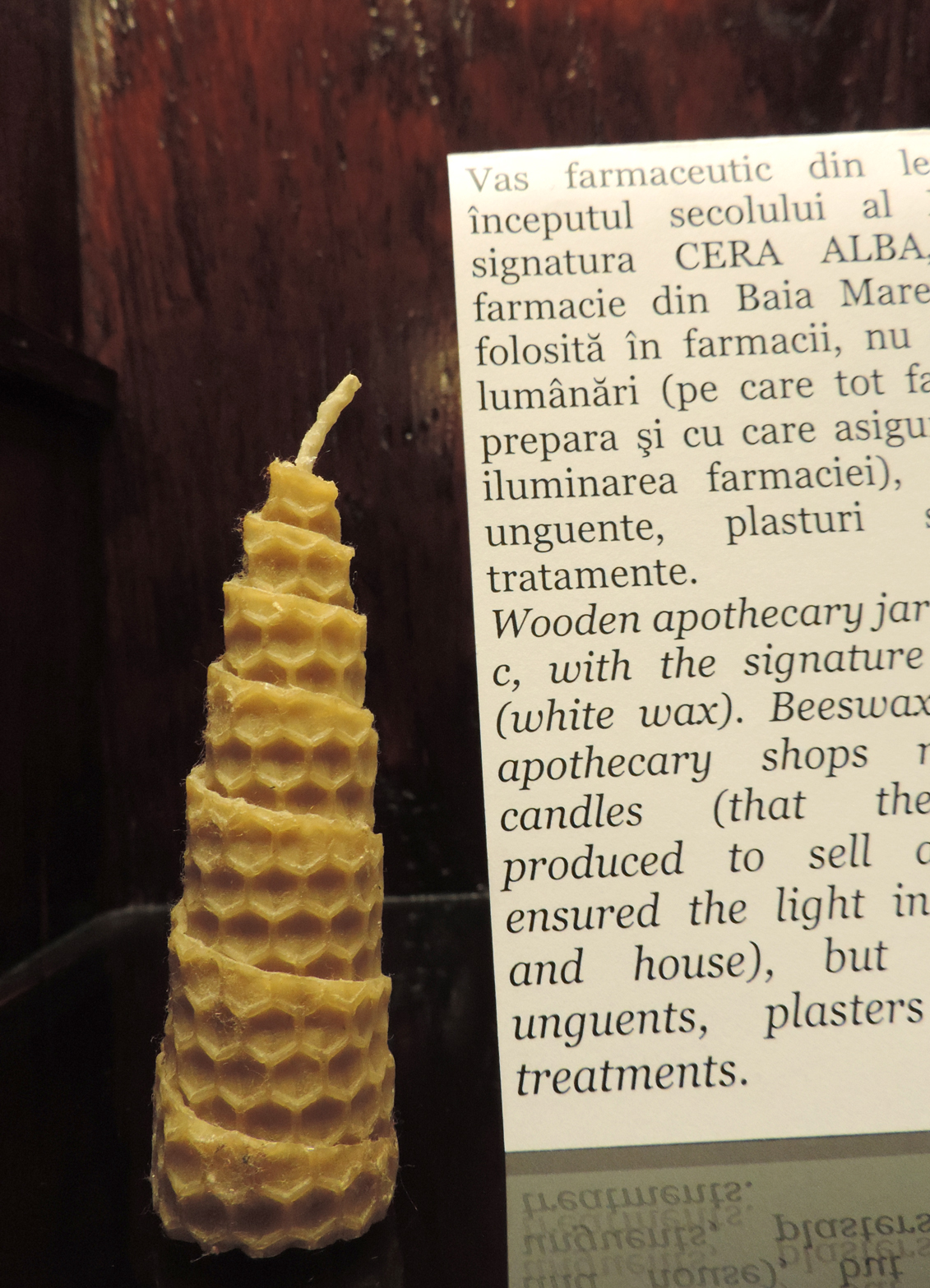
Beeswax was used in apothecary shops not only for candles (that the pharmacist produced to sell and that also ensured the light in his pharmacy and house), but were also part of unguents, plasters and various treatments. 
 
Candle-making device and candle hand-modeling board in the pharmacy museum from Krakow. Taken from Istvan Budahazi, Contributii la istoria farmaciei oradene, 2007, p. 28.

The History of Pharmacy Collection in Cluj-Napoca, part of the National history Museum of Transylvania, exhibits in the "Animals that heal" temporary exhibition currently on display in the Hintz House, a wooden apothecary jar from the 19th c, with the signature CERA ALBA (white wax). 

Natural beeswax candle, in the "Animals that heal" temporary exhibition

Detail of the "CERA ALBA" signature on a wooden apothecary jar, in the "Animals that heal" temporary exhibition

23/12/2016

Egyptian Collection in Cluj-Napoca

One of the collections of the National History Museum of Transylvania in Cluj-Napoca consists of several dozens of ancient Egyptian artifacts and nineteenth-century gypsum replicas of Egyptian famous sculptures made by the Brucianni&co Company that also sold to the British Museum such replicas.
The most valuable artifact among the lot is the mummy and painted sarcophagus of a woman, but there are also animal mummies and mummified organs (lungs, phaluses, hand), ushabtis glazed faience statuettes, Djed amulets and several other artifacts.
The Egyptian collection is not currently on display, as the museum is under renovation for several years, but the new exhibition envisages a special hall to present these exotic patrimony goods.


16/12/2016

Medical equipment collection poster

Museum patrimony and collections from Romania will be presented in 2017 through a poster exhibition organized in Sibiu by the Brukenthal Museum. The "Pompiliu Manea" collection of medical equipment in display in the Hintz House in Cluj besides the history of pharmacy collection is one of the topics of such posters created by the specialists of the National History Museum of Transylvania.
I have presented the collection HERE.
And details of one of the items, an artificial breathing machine, HERE.
 

28/11/2016

New book out soon

My most recent book, entitled "FOCUS - The History of Pharmacy Collection in Cluj-Napoca", will soon be available. It is a bilingual (Romanian-English) popularizing presentation of the pharmacy collection and of its most bizarre ingredients and products. The presentation is structured according to the nature of the ingredients (of human, animal, mineral and vegetal origin), followed by some of the most common products such as tooth powders and elixirs. I have appended a glossary of terms, as some are a bit specialized, and a brief, basic bibliography of works dealing with the history of pharmacy in Transylvania.


13/11/2016

Doors Open Days

The History of Pharmacy Museum in Cluj prepares for another special event on November 26th, the last Saturday of the month, between 10 and 4. Visitors shall gain free access to the main exhibition and to the temporary exhibition Gold and Gems at the Pharmacy that is open until the end of the year. The main even though is that we shall organize a small fair with historical and contemporary postcards, on sale starting with 10 bani a piece! There are Communist postcards depicting views of the City and of the History Museum, contemporary cards with views from the History of Pharmacy Museum, nineteenth century reproductions of watercolors with the princes of Transylvania and guild diplomas from Cluj from the same century.


25/02/2016

Lard and the old apothecary shops of Transylvania


Axungia porci [lard] is very important for apothecaries as it is used in large quantities for pomades and unguents. One should buy lard before Christmas, in the months of November and December, when it is best and cheapest. The butcher’s opinion must be taken into consideration. It is best to buy large fat pigs or pigs fed with corn, since their fat is hard. Other lards are softer and never solidify, unlike lard from pigs fed with corn. In summer it melts and turns into oil and is thus unsuitable for preparing unguents.”
 Tobias Maucksch (1752-1802) thus advised his son Johann Martin in 1793 in his famous INSTRUCTIO that describes the functioning of the "Golden Stag" pharmacy from Târgu Mureş.
 
Details of the signatures of apothecary jars for the preservation of lard

The History of Pharmacy Collection of Cluj-Napoca, part of the National History Museum of Transylvania, includes four jars made of faience and porcelain for the preservation of lard. They are inscribed AXUNGIA PORCI, sometimes in shortened forms. Three of the jars are dated to the nineteenth century and one to the eighteenth century and they had been used in Saint George’s pharmacy from Cluj-Napoca (where we are now), the Engel pharmacy from Iaşi and the pharmacy of the Misericordians from Oradea [Ordo Sancti Joannis de Deo]. 
This FOCUS group is the mini-exhibition for the month of March 2016 at the collection in Unirii Square 28, in the heart of Cluj-Napoca. For details of other temporary exhibition, tickets, timetable, see the blog in Romanian HERE.
For the Romanian version of this article, see the official blog of the collection HERE
Exhibit of the month section at the History of Pharmacy Collection in Cluj-Napoca

02/02/2016

Apothecary uses of cinnamon


The name was and still is used for the aromatic bark of two species of plants: Cinnamomum cassia (“Chinese cinnamon”) and Cinnamomumzeylanicum (“true cinnamon”), both indigenous to south-eastern Asia. The differences between them are rather small: the latter bark is lighter in color, more frail, with a more delicate, but richer taste. Pharmaceutical sources from Transylvania include both terms– Cassia and Cinamom.


 The plant was known and used since antiquity. There are biblical references for the use of cinnamon oil in the temple from Jerusalem and Greek and Roman doctors used it frequently. It was an expensive gift, worthy of royalty and the gods. In the Middle Ages it was an exotic, luxury good, used both in healing and as a spice for cooking and an ingredient for perfumes.
 The properties of cinnamon recommend it as hypotensive, anti-inflammatory, anti-fungal, and analgesic. It was often used in digestive problems. The midwifery manuals of the Early Modern period it is the post popular remedy for female problems and in birth giving, as it stimulates uterine contractions and stops uterine hemorrhage. 


Cinnamon was always used to incite the senses. The Bible records the habit of scenting the lovers’ bed with cinnamon, myrrh, and aloe, while the Queen of Sheba used cinnamon essential oil to seduce King Solomon. Later on, its aphrodisiac properties were increased by its exotic origin and it was used in sensual perfumes, elixirs of love and recipes meant to “incite the passions of Venus”.


 The History of Pharmacy Collection of Cluj-Napoca, part of the National History Museum of Transylvania, includes 12 pharmaceutical vessels, dated to the eighteenth and nineteenth centuries, for different ingredients and substances made of cinnamon: powder, pulp, essential oil, syrup, or tincture. The number and diversity of these vessels (made of wood, transparent and opaque class, faience) reflect its popularity as a pharmaceutical ingredient.

25/06/2009

Recomandare - expo Metamorfozele Evei

De vazut expozitia temporara de la Muzeul national de Istorie a Transilvaniei, str. C-tin Daicoviciu nr. 2, orar:
Marti, Miercuri, Vineri, Sambata, 10-16
Joi 12-18
Daca tot mergeti, vizitati si tezaurul, biletul e foooarte ieftin :)

New exhibition at the National History Museum of Transylvania, dedicated to female costumes through the ages, based on archaeological discoveries. The exhibition was initiated by the students of the MA group "Archaeology and Classical Studies" of the Babes-Bolyai University.

18/01/2009

Temples and amfitheatre models - Ulpia Traiana Sarmizegetusa and Sarmizegetusa Regia


Entrance to the Roman amphitheater in Ulpia Traiana Sarmizegetusa, the capital of the province Dacia. Detail of the gypsum model.

Detail of the gypsum model of the amphitheater.

The "round sanctuary" from Sarmizegetusa Regia, the capital of the Dacian kingdom. Detail of the model.

Column bases from another Dacian sanctuary. Detail of a model.


As all old-fashion, respectable museum institutions across Europe, the National History Museum of Transylvania owns and displays a series of models of archaeological sites. The most aesthetic ones (though, apparently, not very up-to-date) are those of the two Sarmizegetusas, i.e. the Roman amphitheater in the capital of the province of Dacia (Ulpia Traiana Sarmizegetusa...) and the religious area of the ancient Dacian capital known as Sarmizegetusa Regia. I was delighted of these macro photographs of the details, especially under the morning sun.