Showing posts with label cream. Show all posts

05/01/2017

Beeswax in old apothecary shops


Among the  ingredients of animal origin most often employed in the apothecary shops of the medieval and early modern periods one can mention honey and wax. Still used in numerous natural cures today, apiculture products featured in the past as well.
Rose honey, MEL. ROSATUM (or Mellis Rosae)  was used as such, due to its emollient and lenitive (calming pain) properties, but was also an ingredient in various composite drugs (especially gargles and creams).
Rose honey display at the History of Pharmacy Collection in Cuj-Napoca, August 2016
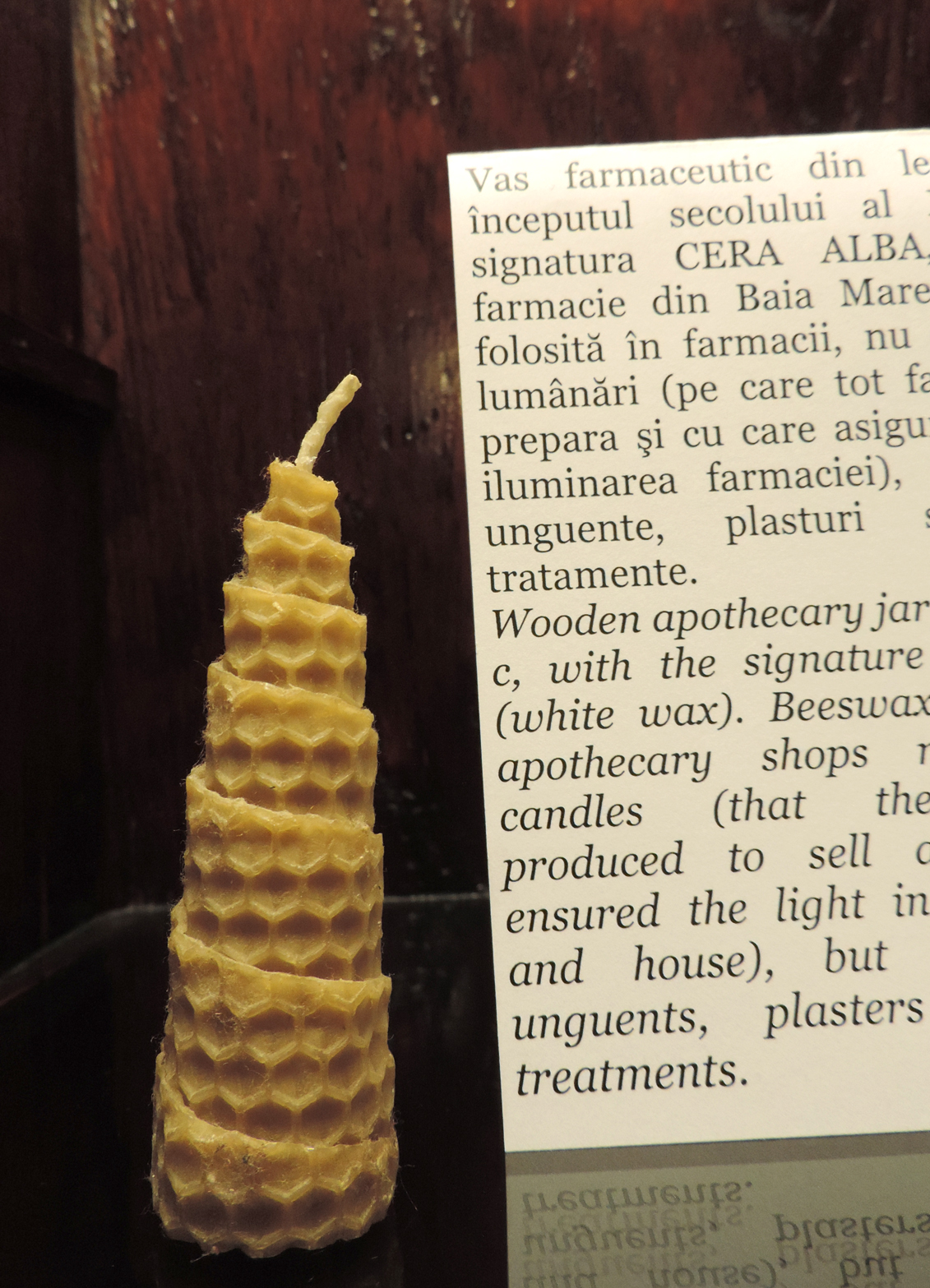
Beeswax was used in apothecary shops not only for candles (that the pharmacist produced to sell and that also ensured the light in his pharmacy and house), but were also part of unguents, plasters and various treatments. 
 
Candle-making device and candle hand-modeling board in the pharmacy museum from Krakow. Taken from Istvan Budahazi, Contributii la istoria farmaciei oradene, 2007, p. 28.

The History of Pharmacy Collection in Cluj-Napoca, part of the National history Museum of Transylvania, exhibits in the "Animals that heal" temporary exhibition currently on display in the Hintz House, a wooden apothecary jar from the 19th c, with the signature CERA ALBA (white wax). 

Natural beeswax candle, in the "Animals that heal" temporary exhibition

Detail of the "CERA ALBA" signature on a wooden apothecary jar, in the "Animals that heal" temporary exhibition

27/07/2016

Rose honey


The FOCUS exhibit of August 2016 at the History of Pharmacy Collection in Cluj-Napoca deals with one of the basic apothecary products in entire Europe, i.e. rose honey.
Rose honey, MEL. ROSATUM (or Mellis Rosae) was one of the most common and often used products of the medieval and pre-modern pharmacies. For his reason it is also known as Mel rosatum commune, sive foliatum (common rose honey, as there were other variations as well). Apothecary dispensatories mention different way of preparing it. Some pharmacists mixed red roses (Rosa centifolia) in honey and left the mix in the sun; others boiled the petals, not to dry but not too fresh either, in honey, while yet others obtained a juice from the petals and then mixed it with honey.


The product was used as such, due to its emollient and lenitive (calming pain) properties, but was also an ingredient in various composite drugs (especially gargles and creams).
The History of Pharmacy Collection in Cluj-Napoca includes just two jars for rose honey, both dated to the nineteenth century and made of porcelain. The first was used in the Mathias Corvinus pharmacy in Cluj (1815), while the second was once used in Iaşi, in the Engel pharmacy there.

1815 porcelain apothecary jar from Cluj

25/02/2016

Lard and the old apothecary shops of Transylvania


“Axungia porci [lard] is very important for apothecaries as it is used in large quantities for pomades and unguents. One should buy lard before Christmas, in the months of November and December, when it is best and cheapest. The butcher’s opinion must be taken into consideration. It is best to buy large fat pigs or pigs fed with corn, since their fat is hard. Other lards are softer and never solidify, unlike lard from pigs fed with corn. In summer it melts and turns into oil and is thus unsuitable for preparing unguents.”
 Tobias Maucksch (1752-1802) thus advised his son Johann Martin in 1793 in his famous INSTRUCTIO that describes the functioning of the "Golden Stag" pharmacy from Târgu Mureş.
 
Details of the signatures of apothecary jars for the preservation of lard

The History of Pharmacy Collection of Cluj-Napoca, part of the National History Museum of Transylvania, includes four jars made of faience and porcelain for the preservation of lard. They are inscribed AXUNGIA PORCI, sometimes in shortened forms. Three of the jars are dated to the nineteenth century and one to the eighteenth century and they had been used in Saint George’s pharmacy from Cluj-Napoca (where we are now), the Engel pharmacy from Iaşi and the pharmacy of the Misericordians from Oradea [Ordo Sancti Joannis de Deo]. 
This FOCUS group is the mini-exhibition for the month of March 2016 at the collection in Unirii Square 28, in the heart of Cluj-Napoca. For details of other temporary exhibition, tickets, timetable, see the blog in Romanian HERE.
For the Romanian version of this article, see the official blog of the collection HERE. 
Exhibit of the month section at the History of Pharmacy Collection in Cluj-Napoca