Showing posts with label Transylvania. Show all posts

04/03/2018

Medieval tower bookmark

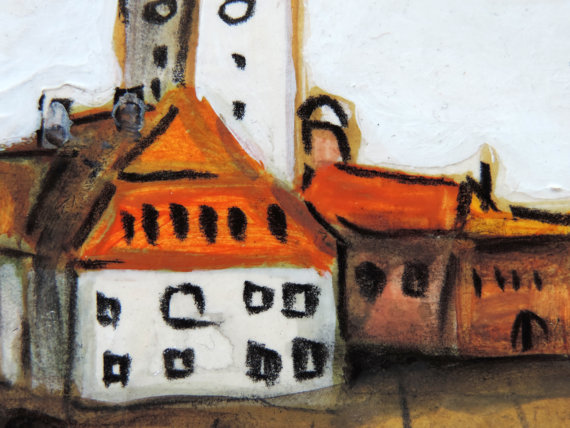
My new creation are these unique bookmarks depicting the old town hall tower of Sibiu, in Transylvania, Romania. Available in my other Etsy store, the Transylvanian Trove. A shop that wishes to promote the creativity and talent of fellow Transylvanians, past and present.
Entirely handmade linocut prints, several combinations of colors available (in both typographic ink and paper). If you have any preference based on item photos, let me know and I will do my best to accommodate (depending on already sold items). Otherwise, I shall randomly choose.

Medieval tower bookmark, hand-pulled linocut print, colorful book accessory, old tower, art gift for readers, writers, book lovers, reading

Dimensions: 14 x 5.5 cm.
The price refers to one bookmark.
Ready to send, ready to use.

See more bookmarks here: https://www.etsy.com/shop/TransylvanianTrove?ref=seller-platform-mcnav§ion_id=20828284
See my entire shop: www.etsy.com/shop/TransylvanianTrove

10/09/2017

Collectibles from Transylvania

Handle -

Dracula, small metal spoon, enamel, vampire, bat, blood drops, Romania, collectible spoon by the Transylvanian Trove, Halloween gift 

I have recently added to my Etsy shop the Transylvanian Trove this collectible little spoon from Romania with vampire decoration: the handle is in the shape of Dracula and the bowl is decorated with bats and blood drops. Inscribed "Romania" and "Dracula" in archaic font. It is made of common metal alloy (not silver), with enamel decoration in white, black and red on the front, while the back is left undecorated. Dimensions: 12 x 2.5 cm (4.7 x 0.9 inches).
Spoon bowl - Dracula, Romania

Lot of 25 vintage metal pins, collection of pins from different countries, fashion accessories, collectibles, traveling souvenirs

 My shop also includes another collectibles item, a lot of 25 metal pins from different countries that I have visited (Spain, Italy, Slovakia, Poland, Andorra, Austria, Slovenia etc.) and organizations (UNV, UNCCD).

13/06/2017

Linocuts and Transylvanian landmarks

In many of her artworks, including linocut prints, Goddess Gruia draws inspiration from special landmarks from her native Transylvania. These models are often medieval monuments, but also various cityscapes and architectural elements from various eras. Here are some examples that also feature in some of the artist's large-size linocuts that are also available on Etsy:
Large-size linocut from Transylvania by Ana-Maria Gruia
The examples are from the historical center of the city of Cluj (the so-called Tailors' Bastion, in fact one of the towers of the 15th century fortified precinct, better preserved due to its restoration during the 17th century following a gunpowder explosion; and the church of the former Dominican monastery, currently Franciscan, in the city's initial medieval square, the so-called Ovar, today Museum's Square) and the Saxon fortified church in Calnic.
Linocut detail - The Tailors' Bastion in Cluj - by Ana-Maria Gruia
The Tailors' Bastion, in fact one of the corner towers of the second fortified precinct of Cluj

Linocut detail - church of the Dominican monastery in Museum's Square of Cluj - by Ana-Maria Gruia

Church of the Dominican monastery, later on Franciscan, in Cluj-Napoca
Artistic perspective over Calnic - keep, water well, fortified precinct, and gate tower - linocut by Ana-Maria Gruia
Water well and segment of the courtain wall inside the fortified Saxon church in Calnic, Alba County


16/05/2017

Vintage prints from Transylvania

The Transylvanin Trove on Etsy sells some original vintage prints from this special province of Central-Eastern Europe. The more valuable item is a 2014 imprint after an 18th century plate from the collection of the National History Museum of Transylvania, a Baroque depiction of flowers with a tiny view over the city of Targu Mures. Under the central floral composition one can see on the left a small city vedutta (probably a view of Targu Mures, in Transylvania) and the engraver's name and year: Josephus Vasarhellyi (in Latinized Hungarian meaning Joseph from Vasarhely=Targu Mures) 1772. According to the name, the author was a Hungarian master from Transylvania. Etching, numbered in pencil 9/I. Material: sepia typographic ink, printing paper. See the etching on Etsy HERE.

Heart flowers, original vintage etching print after an eighteenth century plate, small view of Targu Mures city, Transylvania, Baroque deco

The second, but more recently added, is a beautiful original engraving on handmade paper, depicting a jumping stag against a field of flowers and small leaves in a circle. The circular depiction is surrounded by the inscription "Handmade paper & print by Natura Paper". Materials: black typographic ink, beige handmade paper. Dimensions (total): 18 x 13 cm (7 x 5 inches). Unique vintage print, only one copy vailable, ready to send. See this print on Etsy HERE.

Stag engraving on handmade paper, original print by Natura Paper from Transylvania, etching deer and flowers in circle, vintage printmaking


29/03/2017

Street front in an imaginary green city

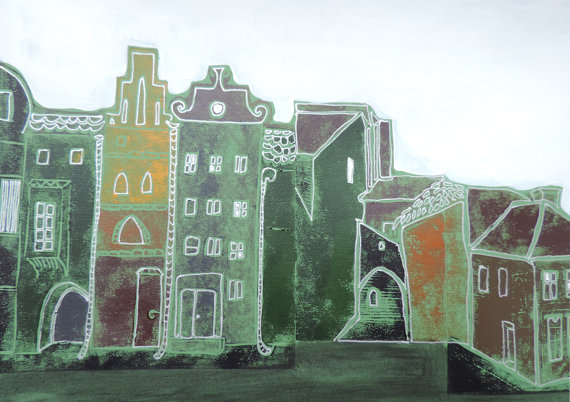
I have just renewed on Etsy a large-size linocut I made a couple of years ago, entitled "Street front in an imaginary green city". This large-size linocut work is part of a series imagining street fronts through the combination of my favored independent lino plates depicting architectural elements. The separate houses, towers, and synagogue are inspired by actual places in east-central Europe, from the cities of Cluj-Napoca, Sibiu, and Dej (Transylvania, Romania) but also Torun (Poland). The unifying elements are color - in this case the green paper, and graphic interventions in silver for the contours.
I find it difficult to work directly on large formats, so my larger works are created through combinations (different linocut plates, like in this case, or collage, like in several others works you can see on my website www.anamariagruia.ro).
It is an appealing sofa-size artwork that will bring color and joy.
Dimensions: 26 x 68.5 cm (10.2 x 26.9 inches).

Street front in an imaginary green city, greenery 2017, emerald green, large-size linocut, architecture, original artwork by Goddess Gruia


Detail of linocut by Ana-Maria Gruia

Detail of linocut by Ana-Maria Gruia
Do not miss the sales coupon available on my shop, the Goddess Gruia on Etsy until the end of March 2017. 20% off on all prices using the code SPRING.
This season opportunity is about to expire - just 3 more days! 

Goddess Gruia is the patron of modesty, asymmetry, self-love and self-irony, peace, women museographers, hypochondriacs, slave reenactors, women artists, fat ballerinas, small business owners and many others! Buy these pieces of original art that are contact relics (have been touched by the goddess) and you will immediately feel the benefices!
Read the monograph here: https://issuu.com/anamariagruia/docs/gg_carte_tot_mic/3?e=3801591/39284262

12/01/2017

Apothecary uses of rose chafer


Cetonia aurata is one of the insect species used as apothecary ingredients, besides the Cantharidae (Spanish fly or soldier beetle) and others.
The rose chafer is the insect closest to the ancient scarab, with its metallic, golden shine. It is common throughout Europe (less so in the northern part of the continent). During the nineteenth century the beetle was considered an efficient cure against rabies.
Vintage engraving of a rose chafer (Cetonia aurata)


Such ingredients are exhibited part of the "Animals that heal" temporary exhibition currently on display in Cluj-Napoca, at the History of Pharmacy Collection (Unirii Square 28). One of the artifacts is a small glass bottle for Cetonia aurata dilution from a 19th-c. homeopathy set from a pharmacy in Baia Mare. Homeopathic dilutions are diluted forms of certain substances. there are several kinds of dilution: decimal (1:10), cent decimal (1:100) or even higher, through successive repetition.

Homeopathy bottle with paper label Cetonia aur. and cork stopper
 
Detail of the homeopathy set from Baia Mare

10/01/2017

Ox gull - FEL TAURI


Ox gull or Bilis bovina - FEL TAURI in apothecary terms- was used ever since Antiquity in the treatment of eye, stomach and intestine problems, of hemorrhoids, but was also part of numerous mixed medicines.

Three apothecary jars for bull’s bile are exhibited part of the "Animals that heal" temporary exhibition at the History of Pharmacy Collection in Cluj-Napoca, part of the National History Museum of Transylvania:

§    white ceramic jar with the signature EXTR. FELL. TAURI in Latin and Hungarian, dated 1815 and used in the Matei Corvin Pharmacy in Cluj. The signature is placed in an oval cartouche with golden border

§ white ceramic jar inscribed EXTR. FEL TAURI from the beginning of the 19th century, Timiş, manufactured in Batiz. The signature is placed in a shield-shaped cartouche with green border, surmounted by a painted decoration consisting of two branches and a central bow

§       glass jar with paper label with the depiction of bulls, beginning of the 20th c., Unicorn Pharmacy in Cluj, partially effaced print and French writing

Apothecary jars for ox-gall

04/01/2017

Apothecary uses of goat's blood


Domestic goat (Capra aegagrus hircus) blood – SANGUIS HIRCI - was used since Antiquity against dysentery and dropsy (water retention due to cardiac failure), while the Arabs recommended it against calculi (stones as pathological products of different human organs). It was also included in the Transylvanian Materia Medica, as the History of Pharmacy Collection in Cluj-Napoca includes a 19th-c. wooden jar with the signature SANGUIS HIRC. The container was once used in the Bononi pharmacy from Recaş, Timiş County. 
The ingredient is but one of the numerous medicines obtained from animals and insects presented in the temporary exhibition "Animale vindecatoare" Animals that Heal - January-June 2017 at the History of Pharmacy Collection, Unirii Square no. 28.

Detail of animal blood vial in the Animals that heal exhibition

Wooden apothecary jar inscribed "Sangv: hirc:"

02/01/2017

Ode to Cluj

One of my small-format paintings (20 x 20 cm - 7.9 x 7.9 inches) is inspired by my hometown, Cluj-Napoca, in Transylvania, Romania. The center of the city is dominated by the Gothic church of St. Michael and I have chosen the same majestic building as the focus of this collage. I have used linocut and acrylic on canvas and the contrast between dark green and orange.
"Ode to Cluj" is now available in my Etsy shop - Goddess Gruia

Ode to Cluj - miniature collage

Detail of linocut print collage

Detail of the towers in central Cluj-Napoca

Detail of St. Michael's Gothic church linocut

21/12/2016

Marin Gruia - watercolors

Though Marin Gruia's favorite techniques are oil and pastel, he has recently developed an interest in watercolor and the results are quite interesting, in the way his particular pastel-color, sensitive landscapes are adapted to the new medium.
© Marin Gruia

© Marin Gruia

© Marin Gruia

© Marin Gruia
 

01/12/2016

Golden network

Another mix technique miniature I made last year is special through the gold leaf experiment I made. The idea was to somehow suggest the tight network of local medieval communities, so I created an ethereal (though not quite ethereal enough)  golden net in the sky. The overall effect is rather Baroque, with the too bright combination of white and gold, so new time I shall paint the sky darker and render the net lines thinner (if such is possible with mixtion and metal foil).
The imagine scene is placed in the medieval town on Sibiu/Hermanstadt, in Transylvania, easily recognizable through the eye-shaped opening at roof level and the unmistakable shape of the medieval tower separating the large and small town squares.


 Just like the previously presented miniature depicting the fortified church in Calnic, this one is also made in a combination of techniques: linocut, collage, acrylic on canvas gold leaf and is ready to hang, provided with a saw tooth hanger (allowing perfect balance and balance corrections if needed) and canvas stretchers already in place, on the back (if, due to display or storage conditions the canvas should need stretching in the future, the pegs are just pushed in a bit). 


30/11/2016

Medievalish painting from Calnic

One of my last year's paintings is inspired by the nicely preserved medieval atmosphere of the fortified Saxon church in Calnic (Alba County, Transylvania). 
It depicts the curtain wall and the medieval keep in the background and a holy scene in the foreground: the Virgin and St. Catherine (with their respective iconographic attributed, the vase with lilies and the wheel).
The miniature is made in a combination of techniques: linocut, collage, acrylic on canvas and is ready to hang, provided with a sawtooth hanger (allowing perfect balance and balance corrections if needed) and canvas stretchers already in place, on the back (if, due to display or storage conditions the canvas should need stretching in the future, the pegs are just pushed in a bit).


15/11/2016

Apothecaries and cures in Early Modern Cluj

This is the title of my latest presentation delivered during the "Cluj/Kolozsvár/Klausenburg – 700" international conference held in Cluj-Napoca by the Sapientia and Babes Bolyai Universities. My presentation attempted to reconstruct the Early Modern history of apothecary shops and pharmacies of Cluj (i.e. between the 16th and the 18th century), identifying traits and developments in the field  (in comparison to the rest of Transylvania and Western Europe) and to verify is there are any novel strategies in marketing and retail employed by pharmacists to boost their sales. Until the article is finished for the collective volume of the conference, fell free to check my presentation on academia.edu HERE.
The full program of the conference is available in Romanian HERE.

One of the documents preserved at the History of Pharmacy Collection in Cluj is an eighteenth-century manuscript, a tariffs project by Tobias Maucksch or Mauksch, the privileged pharmacist of Cluj, owner of the apothecary shop hosting the museum today.

02/11/2016

Original miniature by Goddess Gruia

I've been renewing, reducing prices and polishing my Etsy Shop in preparation for the holidays season and I have rediscovered one of my personal favorites - a bright miniature inspired by the old town center of Brasov (Kronstadt), a Saxon town in southern Transylvania, in Romania.
Through a mix technique (pencil sketch and acrylic colors) I tried to capture the charming perspective, color, and light of this area, called "The Town Council House" (i.e. the town hall).
Dimensions: 9.5 x 10 cm (3.7 x 3.9 inches). 
Feel free to visit GoddessGruia temple aka Etsy Shop HERE
See the listing HERE.
The work can be included among my medieval architecture-inspired acrylic paintings that I have presented before.


02/10/2016

Goddess Gruia. A Monograph. Free online

The promised and much awaited monograph book / art album of Goddess Gruia has finally been published. It contained everything about her cult, traits, iconography and worship. Read it now for your own benefit!

See also previous articles on the topic:

16/09/2016

Gilded linocut prints

Goddess Gruia had been busy today in her Sancta Sanctorum gilding linocut prints (contact relics). The project was a first for her, as she has applied gold foil to acrylic paintings and canvas, but never on paper, on simple linocuts. The experiment envisaged several combinations of motifs in Transylvanian cartouche printed on white paper, the result being rather Baroque (the combination of white and gold), but also one try, the best in her opinion, on black paper. It does go better on black, right?