Showing posts with label apothecary history. Show all posts

25/06/2017

Pharmacy and alchemy

The next temporary exhibition at the History of Pharmacy Collection in Cluj-Napoca focuses on the interferences between pharmacy and alchemy. The exhibition, open between July 3rd and December 31st 2017, consists of a proper temporary exhibition, focused around four major topics, and a thematic tour through the permanent collection. The four topics explored, illustrated with relevant artifacts from the history of pharmacy, are: Pharmacy and Alchemy, Laboratory tools, Alchemical symbols, and Alchemical confusions. The tour is properly indicated with printed signs depicting the so-called Mirabilitas Naturae (Nature's miraculous abilities) taken from Maier Viatorium ~1618.
Join the Facebook event HERE to receive the latest news. 
The four topics of the exhibition and all the labels are bilingual, Romanian and English, so tourists are encouraged to visit and explore the alchemical elements and tools borrowed by the old apothecaries of Transylvania.
 

Mirabilitas Naturae
 

10/03/2017

FOCUS The History of Pharmacy Collection in Cluj-Napoca

A new book is now available on the History of Pharmacy Collection from Cluj-Napoca, in full color and bilingual text (Romanian and English). It is available at the collection, in Unirii Square 28, or at the mother institution, the History Museum on Daicoviciu St. 2.

Ana-Maria Gruia, FOCUS Colecţia de Istorie a Farmaciei din Cluj-Napoca.  History of Pharmacy Collection in Cluj-Napoca, Ed. Argonaut, Muzeul Naţional de Istorie a Transilvaniei, 2016, 200 p.


Introduction

            This is a brief incursion into the history of spices, of exotic ingredients, of pharmacy and healing, of mentalities in Transylvania, with notes connected to commerce and selling, collectors, and the history of museums.
            The catalogue groups some of the most interesting ingredients or products sold in the apothecary shops of old, including several introductory pages on the history of the pharmacies in Cluj and the present-day collection of the museum. The majority of these ingredients have been presented between 2014 and 2016 at the History of Pharmacy Collection part of small exhibits entitled “FOCUS – exhibit of the month”, completed and accompanied by English translations. Others have been discussed during temporary exhibitions such as “On pipes and smoking in Transylvania” (November 2014-February 2015), “The History of Aphrodisiacs” (February-May 2015), “Harry Potter and the Real History of Pharmacy” (November 2015 – May 2016) and “The History of Poison” (May-August 2016) and during several thematic events. The Romanian versions of almost all of the texts have been published in Făclia under the series entitled “Exhibit of the Month at the History of Pharmacy Collection”.
The catalogue presents ingredients of various origins (human, animal, vegetal, mineral) and several pharmaceutical and para-pharmaceutical products sold in Transylvania during the Early Modern and Modern Eras.
The present volume starts with the presentation of the old pharmacy that currently hosts the History of Pharmacy Collection and in the end I have appended a glossary of specific or less usual terms, and a basic bibliography of works discussing the history of pharmacy in Transylvania.


16/01/2017

Apothecary ingredients obtained from humans


Among the ingredients from living creatures once used in the old apothecary shops one can include those obtained from humans. Naturally, they were less numerous than those collected or extracted from various species of insects and animals, both local and exotic, but their fame was presumed effects were greater.

§      human fat (Axungia hominis), used as base for unguents between the sixteenth and the eighteenth century,
Early Modern apothecary jars for human fat at the Apothekenmuseum Heidelberg, Germany

§      shavings of human skull (Cranii humani rasura) sometimes employed as calcium supplement
§      mummy powder (Pulvis Mumiae Verae), considered a universal medicine and sold for its weight in gold.
  
18th-century mummy powder (Pulvis Mumiae Verae) from the History of Pharmacy Collection in Cluj-Napoca, Romania
Sometimes pharmacists obtained such products from the corpses of executed prisoners, others - like the mummy powder - were the focus of specialized long-distance trade.
For the animal ingredients see the recent temporary exhibition in Cluj-Napoca entitled "Animals that heal". 

12/01/2017

Apothecary uses of rose chafer


Cetonia aurata is one of the insect species used as apothecary ingredients, besides the Cantharidae (Spanish fly or soldier beetle) and others.
The rose chafer is the insect closest to the ancient scarab, with its metallic, golden shine. It is common throughout Europe (less so in the northern part of the continent). During the nineteenth century the beetle was considered an efficient cure against rabies.
Vintage engraving of a rose chafer (Cetonia aurata)


Such ingredients are exhibited part of the "Animals that heal" temporary exhibition currently on display in Cluj-Napoca, at the History of Pharmacy Collection (Unirii Square 28). One of the artifacts is a small glass bottle for Cetonia aurata dilution from a 19th-c. homeopathy set from a pharmacy in Baia Mare. Homeopathic dilutions are diluted forms of certain substances. there are several kinds of dilution: decimal (1:10), cent decimal (1:100) or even higher, through successive repetition.

Homeopathy bottle with paper label Cetonia aur. and cork stopper
 
Detail of the homeopathy set from Baia Mare

09/01/2017

Hyraceum and Castoreum


The petrified excrement (both feces and urine) of the rodents of the Cape Hyrax (Procavia capensis) species was used in the apothecary shops of old as a substitute for Castoreum. The latter, a much better known ingredient of animal origin, was obtained from beaver glands, of both sexes, and was used in the treatment of epilepsy, cholera, but also hysteria due to its analgesic and anti-inflammatory properties. Both substances were also used in the perfume industry.
Actual 18th century hyraceum and castoreum samples, plus several early modern and modern apothecary jars for the two products are on display at the History of Pharmacy Collection in Cluj-Napoca part of the temporary exhibition entitled "Animals that heal" [Animale vindecatoare] - on display until the end of June a.c.

Castoreum

19th-c. apothecary jars, made of painted wood and glass, containing Castoreum

Hyraceum
Milky cup, signature HYRACEUM, beginning of the 19th c., from Baia Mare.

06/01/2017

Ambra grisea / ambergris in Transylvania


Ambergris (Lat. ambra grisea) or grey amber, is a solid, waxy, flammable substance of a dull grey or blackish color, produced in the digestive system of sperm whales. Like other secretions and ingredients of animal origin, it was mostly used in the perfume industry, but also had medicinal applications.
vintage engraving of a sperm whale or cachalot

In the European Materia Medica, thus including Transylvania, ambergris was mostly used as cure for vertigo and fainting, presumably also due to its strong odor.
The History of Pharmacy Collection in Cluj-Napoca displays, part of the "Animals that heal" temporary exhibition, a small glass with paper lid and the signature AMBRA GRISEA. The apothecary jar, still containing  pieces of ambergris, is dated to the end of the 19th century and was once used in a pharmacy in Turda, not far from Cluj, the greatest city of Transylvania. 

19th-c. apothecary jar with paper label inscribed AMBRA GRISEA from the History of Pharmacy Collection in Cluj-Napoca

05/01/2017

Beeswax in old apothecary shops


Among the  ingredients of animal origin most often employed in the apothecary shops of the medieval and early modern periods one can mention honey and wax. Still used in numerous natural cures today, apiculture products featured in the past as well.
Rose honey, MEL. ROSATUM (or Mellis Rosaewas used as such, due to its emollient and lenitive (calming pain) properties, but was also an ingredient in various composite drugs (especially gargles and creams).
Rose honey display at the History of Pharmacy Collection in Cuj-Napoca, August 2016
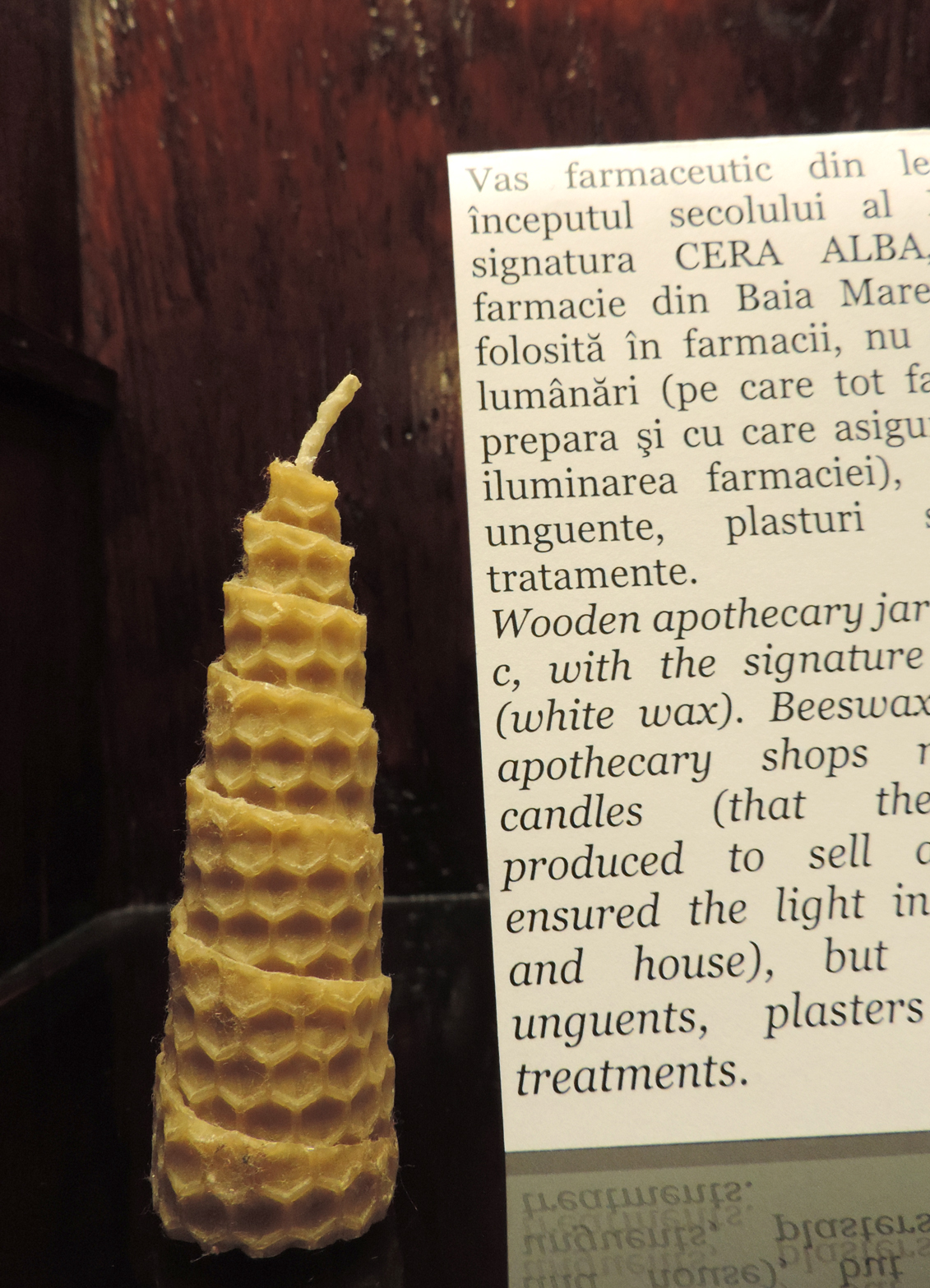
Beeswax was used in apothecary shops not only for candles (that the pharmacist produced to sell and that also ensured the light in his pharmacy and house), but were also part of unguents, plasters and various treatments. 
 
Candle-making device and candle hand-modeling board in the pharmacy museum from Krakow. Taken from Istvan Budahazi, Contributii la istoria farmaciei oradene, 2007, p. 28.

The History of Pharmacy Collection in Cluj-Napoca, part of the National history Museum of Transylvania, exhibits in the "Animals that heal" temporary exhibition currently on display in the Hintz House, a wooden apothecary jar from the 19th c, with the signature CERA ALBA (white wax). 

Natural beeswax candle, in the "Animals that heal" temporary exhibition

Detail of the "CERA ALBA" signature on a wooden apothecary jar, in the "Animals that heal" temporary exhibition

04/01/2017

Apothecary uses of goat's blood


Domestic goat (Capra aegagrus hircus) blood – SANGUIS HIRCI - was used since Antiquity against dysentery and dropsy (water retention due to cardiac failure), while the Arabs recommended it against calculi (stones as pathological products of different human organs). It was also included in the Transylvanian Materia Medica, as the History of Pharmacy Collection in Cluj-Napoca includes a 19th-c. wooden jar with the signature SANGUIS HIRC. The container was once used in the Bononi pharmacy from Recaş, Timiş County. 
The ingredient is but one of the numerous medicines obtained from animals and insects presented in the temporary exhibition "Animale vindecatoare" Animals that Heal - January-June 2017 at the History of Pharmacy Collection, Unirii Square no. 28.

Detail of animal blood vial in the Animals that heal exhibition

Wooden apothecary jar inscribed "Sangv: hirc:"

03/01/2017

Apothecary uses of deer antlers


Deer antlers were a source of calcium, just like other shells and animal bones. The ingredient was used as shavings (rasura), powder (pulveris), volatile salt (sal) or alcoholic solution (spiritus), sometimes meant to be smelled or fumigated as a cure for feminine problems (such as collapsed uterus). 
Vintage engraving of a deer

The blue glass with the signature PULV. CORNU CERVI. (deer antler powder) is from the beginning of the 20th c., from the old St. George Pharmacy hosting the Pharmacy Collection in the center of Cluj, in the Hintz House. The glass with the signature SPIRIT CORNU CERVII (deer antler alcoholic solution) dates from the 18th c. and was used in a pharmacy from Baia Mare, while the small jar for deer antler salt - SALL CORNU CERVI - is from the 19th c., from Bratislava.
Apothecary containers for deer antler products


Apothecary jars for deer antler medicine, actual 18th-century shavings and an entire antler are exhibited part of the "Animals that heal" temporary exhibition at the History of Pharmacy Collection in Cluj-Napoca, on display until June 30th 2017. See the official blog of the museum for how to plan your visit at http://farmacluj.blogspot.ro/

Deer antler display case at the History of Pharmacy Collection in Cluj


29/11/2016

Animals that heal

"Animals that heal" (Animale vindecatoare) is the title of the new temporary exhibition in the making at the History of Pharmacy Collection in Cluj-Napoca. The exhibition will open in the first days of January 2017 and will be on display for six month, in the center of Cluj, in Unirii Square no. 28.

Rather numerous medieval and early modern apothecary ingredients were obtained from animals and insects. The eighteenth-century written sources from Transylvania, pharmacy inventories, pharmacopoeias, apothecary taxes (lists of ingredients and prices), mention 80 such ingredients, much more than in the era’s Austrian pharmacopoieas for example. Some were exotic, obtained from sperm whales, civet cats, cuttlefish etc., while others were local, obtained from common European species (such as the so-called Spanish fly, bear, deer, pig and others). The ingredients include various organs, secretions or even pathological “products” from the body of the various species of animals, such as the bezoars.
The exhibition shall tell the tale of these less usual medicines and illustrate it with various jars for such ingredients and also historical samples of some of them.
Stay tuned! 


25/11/2016

Apothecary uses of nutmeg


 As the name indicates, nutmeg is the nut-type fruit of the tress from the Myristica fragrans species, native of the Molucca Islands in Indonesia, also knows as the Spice Islands. Nutmeg was used in India traditionally as a cooking spice, but also as a hallucinogen and an aphrodisiac. Arab merchants brought it to Europe in the sixth century, where it was well-known by the twelfth century. It increases blood circulation, fights sleepiness, and is also recommended for cardiac afflictions. The medicinal properties of nutmeg are based on the essential oil they contain and that has the following effects: stimulant, carminative (calms abdominal pain and favor the evacuation of intestinal gas) and in larger dosage narcotic. The oil is also often employed in hiding the unpleasant taste of other medicine.

Detail of nutmeg and blues apothecary glass for such nuts, from the temporary exhibition "The History of aphrodisiacs"
 

The History of Pharmacy Collection in Cluj-Napoca includes five jars for this products, apparently often for entire nuts (Nuces Moschatae) or their oil (Oleum Nucis Moschatae). The majority of the jars were once used in the old St. George’s pharmacy (two glass jars with painted Baroque signatures from the eighteenth century and one blue glass bottle with faceted glass stopper, from the beginning of the twentieth century). Another jar, made of porcelain, has a bilingual inscription – Latin and Hungarian – and was also used in Cluj, in the Mathias Corvinus apothecary shop. The wooden jar was used during the nineteenth century in a pharmacy from Baia Mare.

Eighteenth-century nutmeg oil glass jar. Signature in Baroque cartouche with vegetal volutes and crown.

Nineteenth-century porcelain jar with bilingual signature.


 The collection also preserves the stained glass shop sign of the Mathias Corvinus pharmacy in Cluj-Napoca. The work is signed and dated 1919 and it depicts the kneeling knight - king of Hungary born in Cluj. The cult of king Mathias was blooming in the city during the nineteenth and the beginning of the twentieth century, so it was only natural that a pharmacy located in the center would would depict him and bare his name.


Detail of Mathias Corvinus depicted on the pharmacy shop sign

The FOCUS exhibition thus for December 2016 displays these various apothecary jars for nutmeg, two actual nuts, and the apothecary sign discussed above can be seen in the basement where the laboratory of the old pharmacy is located.


16/11/2016

Zibethum - apothecary cat secretions


Zibethum is obtained from the anal glands of the civet cats of the Viverridae and Nandiniidae families of Africa and Asia. Nowadays the paste in question is used in the perfume industry, but in the eighteenth century it was employed for its pharmaceutical properties, part of several antispasmodic, aphrodisiac, or stimulant products. Since Zibethum was exotic and among the curious ingredients of animal origin, in Transylvanian pharmacies it was mentioned as “Zibethum veris” (real, authentic Zibetum). The stress on its authenticity betrays the clients’ lack of trust in the bizarre products of the era. Similarly, the Mummy Powder was also accompanied by the adjective “veris”.

Old engraving depicting civet cats

Zibethum is mentioned in several of the pharmacy inventories of Transylvania (of Alba Iulia in 1751 and 1752, of Târgu Mureş in 1789), in all three apothecary taxes written for Transylvania during the eighteenth century (by Tobias Maucksch in 1750, by Hutter-Soterius in 1753, by Felfalusi and Ahlefeld in 1753) and in the Pharmacopoeia Austriacoprovincialis of 1774.

Nineteenth-century milky glass apothecary jar inscribed Zibetum and the 1789 inventory of the pharmacy in Targu Mures listing the ingredient.

The History of Pharmacy Collection in Cluj-Napoca includes one jar made of milky glass with the paper label inscribed ZIBETUM and the 1789 inventory of the pharmacy from Târgu Mureş that mentions the product. The glass jar was used in the beginning of the nineteenth century in a pharmacy from Baia Mare – evidence of the fact that the product continued to be used after the end of the eighteenth century as well.
Those who believe the consumption of wild cat secretions is weird must be advised that people’s obsession with these animals’ digestion continues today, as the much appreciated Kopi Luwak coffee is obtained from beans partly digested and eliminated through feces by the wild palm Asian cats.

Kopi Luwak, the most expensive coffee

08/11/2016

The Beans of St. Ignatius


In the end of the seventeenth century the Czech Jesuit brother Georg Joseph Kamel was active as a missionary in the Philipines, but he also performed botanic research in these oriental islands. His drawings and descriptions of local plants eventually reached London (the first lot had been stolen by pirates), where they were published. Kamel was the first to describe a crawling plant that the Philipinese called aguwason, dankkagi, or igasud and he called, scientifically, Strychnos ignatia after St. Ignatius of Loyola, the patron saint of the Jesuit order.


Georg Joseph Kamel

The bitter fruit of this plant, in the shape and size of an orange, has hard, almond-shaped seeds called faba Sancti Ignatii. The beans contain two toxic alkaloids, stricnine and brucine. In small doses they act on the transmission of nerve stimuli towards the muscles and in higher doses can causes death through asphyxiation.

Apothecary jar from the collection.

During the seventeenth and eighteenth centuries the beans were used in curing goiters, cholera, asthma, epilepsy and other afflictions, but their use was limited in time due to their toxic effects. They were rediscovered during the nineteenth century and were used in the making of the homeopathic dilution called Ignatia or Ignatia amara, recommended as remedy against strong emotional suffering and contradictory, hysterical symptoms. It was, and still is mainly used by women who show “symptoms of emotional stress such as headaches, twitches, digestive problems, throat pains and fear of birds (especially chicken)”.
1790 inventory of the pharmacy shop in Targu Mures mentioning Faba Sancti Ignatii

The collection includes three items related to this ingredient: several beans of St. Ignatius, one with grate marks, used during the nineteenth century in the pharmacy from Baia Mare; a small glass bottle marked IGNATIA from a nineteenth-century homeopathy set from the same location, and a glass jar with the signature FABA ST. IGNATII from Valeriu Bologa’s collection.
Small homeopathy bottle for Ignatia.

St. Ignatius' Bean with grate marks.