11/01/2017

Autumn leaf leather earrings

A brand new item has been added to the Transylvanian Trove on Etsy today: entirely handmade leather earrings, incised and spatter-dyed (Jackson Pollock style :). These large earrings, made of sturdy leather are made to last.
See more items in the shop described in a previous post HERE. 
All the earrings available in my shop are available HERE.

Leather earrings, autumn leaf shaped, asymmetrical (framing the face), handmade jewelry, veg tan natural leather, from Transylvania


These original leaf-shaped leather earrings are made of vegetable-tan natural leather, and incised and dyed by hand. The edges are buffered and the surface is treated with two leather seal solutions. Still, it is recommended to take the earrings off while showering, for example, as submerging them in liquids can still cause stains and deformations.
Each pair contains two slightly asymmetrical earrings, each with the tip towards the face/neck, in order to nicely frame it.
Two color variants available: nuances of red and green.
Common metal allow hooks, assorted with the earrings, i.e. reddish and silver in color.
Length: 4.5 cm (1.7 inches) 

10/01/2017

Ox gull - FEL TAURI


Ox gull or Bilis bovina - FEL TAURI in apothecary terms- was used ever since Antiquity in the treatment of eye, stomach and intestine problems, of hemorrhoids, but was also part of numerous mixed medicines.

Three apothecary jars for bull’s bile are exhibited part of the "Animals that heal" temporary exhibition at the History of Pharmacy Collection in Cluj-Napoca, part of the National History Museum of Transylvania:

§    white ceramic jar with the signature EXTR. FELL. TAURI in Latin and Hungarian, dated 1815 and used in the Matei Corvin Pharmacy in Cluj. The signature is placed in an oval cartouche with golden border

§ white ceramic jar inscribed EXTR. FEL TAURI from the beginning of the 19th century, Timiş, manufactured in Batiz. The signature is placed in a shield-shaped cartouche with green border, surmounted by a painted decoration consisting of two branches and a central bow

§       glass jar with paper label with the depiction of bulls, beginning of the 20th c., Unicorn Pharmacy in Cluj, partially effaced print and French writing

Apothecary jars for ox-gall

09/01/2017

Hyraceum and Castoreum


The petrified excrement (both feces and urine) of the rodents of the Cape Hyrax (Procavia capensis) species was used in the apothecary shops of old as a substitute for Castoreum. The latter, a much better known ingredient of animal origin, was obtained from beaver glands, of both sexes, and was used in the treatment of epilepsy, cholera, but also hysteria due to its analgesic and anti-inflammatory properties. Both substances were also used in the perfume industry.
Actual 18th century hyraceum and castoreum samples, plus several early modern and modern apothecary jars for the two products are on display at the History of Pharmacy Collection in Cluj-Napoca part of the temporary exhibition entitled "Animals that heal" [Animale vindecatoare] - on display until the end of June a.c.

Castoreum

19th-c. apothecary jars, made of painted wood and glass, containing Castoreum

Hyraceum
Milky cup, signature HYRACEUM, beginning of the 19th c., from Baia Mare.

08/01/2017

Flowers by Marin Gruia

Though he prefers small and average size formats, my father has recently taken an interest in larger paintings. These are the most recent flowers he made, oil on canvas, 70 x 70 cm, inspired by bouquets they make during the summer at their mountain cabin. I must confess I like the impact of these larger works, the color effect on more generous backgrounds and the freshness of the entire composition.
Feel free to check out and like his Facebook page - Marin Gruia

Flowers,
Oil on canvas, 70 x 70 cm
© Marin Gruia

Flowers,
Oil on canvas, 70 x 70 cm
© Marin Gruia

06/01/2017

Ambra grisea / ambergris in Transylvania


Ambergris (Lat. ambra grisea) or grey amber, is a solid, waxy, flammable substance of a dull grey or blackish color, produced in the digestive system of sperm whales. Like other secretions and ingredients of animal origin, it was mostly used in the perfume industry, but also had medicinal applications.
vintage engraving of a sperm whale or cachalot

In the European Materia Medica, thus including Transylvania, ambergris was mostly used as cure for vertigo and fainting, presumably also due to its strong odor.
The History of Pharmacy Collection in Cluj-Napoca displays, part of the "Animals that heal" temporary exhibition, a small glass with paper lid and the signature AMBRA GRISEA. The apothecary jar, still containing  pieces of ambergris, is dated to the end of the 19th century and was once used in a pharmacy in Turda, not far from Cluj, the greatest city of Transylvania. 

19th-c. apothecary jar with paper label inscribed AMBRA GRISEA from the History of Pharmacy Collection in Cluj-Napoca

05/01/2017

Beeswax in old apothecary shops


Among the  ingredients of animal origin most often employed in the apothecary shops of the medieval and early modern periods one can mention honey and wax. Still used in numerous natural cures today, apiculture products featured in the past as well.
Rose honey, MEL. ROSATUM (or Mellis Rosae)  was used as such, due to its emollient and lenitive (calming pain) properties, but was also an ingredient in various composite drugs (especially gargles and creams).
Rose honey display at the History of Pharmacy Collection in Cuj-Napoca, August 2016
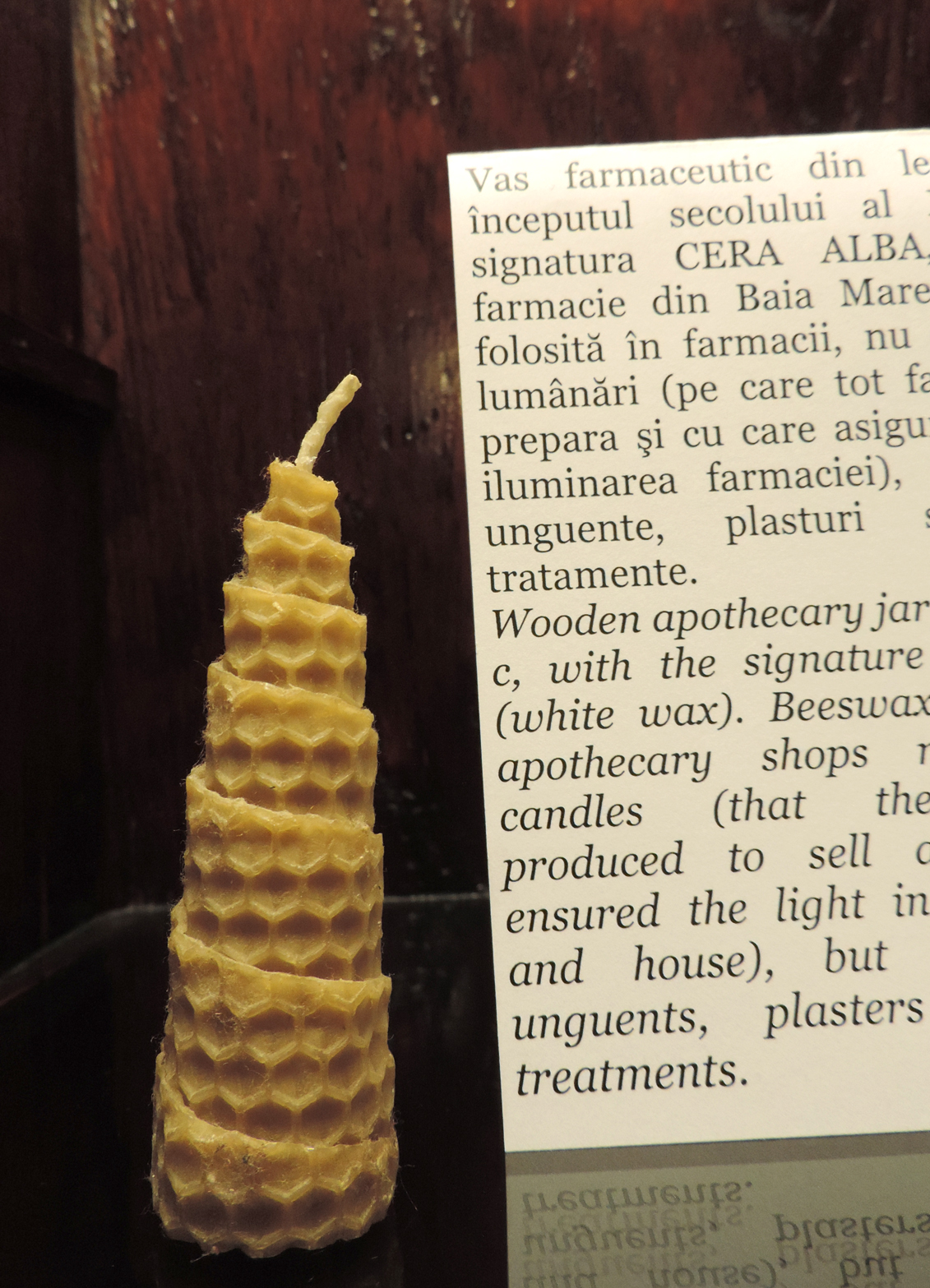
Beeswax was used in apothecary shops not only for candles (that the pharmacist produced to sell and that also ensured the light in his pharmacy and house), but were also part of unguents, plasters and various treatments. 
 
Candle-making device and candle hand-modeling board in the pharmacy museum from Krakow. Taken from Istvan Budahazi, Contributii la istoria farmaciei oradene, 2007, p. 28.

The History of Pharmacy Collection in Cluj-Napoca, part of the National history Museum of Transylvania, exhibits in the "Animals that heal" temporary exhibition currently on display in the Hintz House, a wooden apothecary jar from the 19th c, with the signature CERA ALBA (white wax). 

Natural beeswax candle, in the "Animals that heal" temporary exhibition

Detail of the "CERA ALBA" signature on a wooden apothecary jar, in the "Animals that heal" temporary exhibition

04/01/2017

Apothecary uses of goat's blood


Domestic goat (Capra aegagrus hircus) blood – SANGUIS HIRCI - was used since Antiquity against dysentery and dropsy (water retention due to cardiac failure), while the Arabs recommended it against calculi (stones as pathological products of different human organs). It was also included in the Transylvanian Materia Medica, as the History of Pharmacy Collection in Cluj-Napoca includes a 19th-c. wooden jar with the signature SANGUIS HIRC. The container was once used in the Bononi pharmacy from Recaş, Timiş County. 
The ingredient is but one of the numerous medicines obtained from animals and insects presented in the temporary exhibition "Animale vindecatoare" Animals that Heal - January-June 2017 at the History of Pharmacy Collection, Unirii Square no. 28.

Detail of animal blood vial in the Animals that heal exhibition

Wooden apothecary jar inscribed "Sangv: hirc:"

03/01/2017

Apothecary uses of deer antlers


Deer antlers were a source of calcium, just like other shells and animal bones. The ingredient was used as shavings (rasura), powder (pulveris), volatile salt (sal) or alcoholic solution (spiritus), sometimes meant to be smelled or fumigated as a cure for feminine problems (such as collapsed uterus). 
Vintage engraving of a deer

The blue glass with the signature PULV. CORNU CERVI. (deer antler powder) is from the beginning of the 20th c., from the old St. George Pharmacy hosting the Pharmacy Collection in the center of Cluj, in the Hintz House. The glass with the signature SPIRIT CORNU CERVII (deer antler alcoholic solution) dates from the 18th c. and was used in a pharmacy from Baia Mare, while the small jar for deer antler salt - SALL CORNU CERVI - is from the 19th c., from Bratislava.
Apothecary containers for deer antler products


Apothecary jars for deer antler medicine, actual 18th-century shavings and an entire antler are exhibited part of the "Animals that heal" temporary exhibition at the History of Pharmacy Collection in Cluj-Napoca, on display until June 30th 2017. See the official blog of the museum for how to plan your visit at http://farmacluj.blogspot.ro/

Deer antler display case at the History of Pharmacy Collection in Cluj


02/01/2017

Ode to Cluj

One of my small-format paintings (20 x 20 cm - 7.9 x 7.9 inches) is inspired by my hometown, Cluj-Napoca, in Transylvania, Romania. The center of the city is dominated by the Gothic church of St. Michael and I have chosen the same majestic building as the focus of this collage. I have used linocut and acrylic on canvas and the contrast between dark green and orange.
"Ode to Cluj" is now available in my Etsy shop - Goddess Gruia

Ode to Cluj - miniature collage

Detail of linocut print collage

Detail of the towers in central Cluj-Napoca

Detail of St. Michael's Gothic church linocut

01/01/2017

50% OFF Marin Gruia's oil on canvas Flower paintings

As my Etsy shop Goddess Gruia also promotes two of my father's paintings, these can also be had with 50% discount, applying the reduction coupon code STUDIOMOVE.
The two miniature paintings by Marin Gruia depict flower bouquets in his typical, neoclassical style. He is an established painter from Romania:
Biography:
- Born in 1949, in Dej, Cluj County, Romania, established in Cluj-Napoca.
- BA in organic chemistry (Timisoara, Romania), macromolecular chemistry research activity.
- Free art studies in Bussels (Bortier Gallery), Dortmund (Auslandinstitut), Cluj-Napoca.
Exhibitions in Romania:
• Galeria Filo, Cluj-Napoca, 1982
• Galeria Casei Universitarilor, Cluj-Napoca, 1982 and 1990
• Institutul de Lingvistica,
Cluj-Napoca, 1989
• Galeria Radio-TV,
Cluj-Napoca, 1990
• Painting on faience, Galeria Casei Universitarilor, Cluj-Napoca, 1992
• Muzeul de Arta, Satu-Mare, 1997
• Galeriile Fortuna, Cluj-Napoca, 2008
• Group exhibition, Muzeul de Arta Cluj-Napoca, 2009
Exhibitions abroad:
• Saint Michel, Namur, Belgium, 1990
• Galeria "Bortier" Bruxelles, Belgium, 1991
• Frasnes, Belgium, 1991
• Rheinish-Westfalische Auslandinstitut, Dortmund, Germany,1992
• Auferstehungskirche, Dortmund,Germany,1992
• Group exhibition Tokaj, Hungary, 2004 and 2005
• Group exhibitions organized by Pavot in Romania and UK (London), 2015-2016

Original oil painting, wall art, still life, canvas painting "Flower bouquet" by established artist Marin Gruia from Romania