05/11/2016

Cohors I Batavorum is going shopping

Sunday, November 6th, the brave auxiliary soldiers of the First Batavian Cohort, reenacted by VIRTUS ANTIQUA can be observed in their free time at Polus Center, in Cluj-Napoca! Feel free to observe and interact with Roman soldiers and goddesses in a perfectly anachronical setting. Still, considering that the war season is over and that the warmer climate of Rome is recreated inside the mall, that's where the soldiers will be!


The event is entitled Cohors I Batavorum dimitto ad Polus is inspired by the Latin command "dimitto" ‎(present infinitive dīmittere, perfect active dīmīsī, supine dīmissum); third conjugation, send away, dismiss.
So, come meet the soldiers dismissed for some shopping! You can also join the Facebook event for all the details HERE.

04/11/2016

Pipe lost, pipe found

The European Championship for Slow Pipe Smoking held in Nitra, Slovakia, on 16th October 2016, has also included a conference and poster presentation. "Pipe lost, pipe found" was in fact a colloquium on historical tobacco pipes in Central Europe and the corresponding poster section included more than 15 such presentations, among which my own, dealing with clay pipe finds from Transylvania dated to the seventeenth and eighteenth centuries. Most of the items, clay pipes, pipe fragments, depictions of smokers on stove tiles are from the collection of the National History Museum of Transylvania, Cluj-Napoca.
"Early Modern Pipes from Transylvania" presentation poster READING SIZE HERE
My bookon the topic, "The Gift of Vice. Pipes and the Habit of Smoking in Early Modern Transylvania",  is available on my Academia.edu profile HERE.


02/11/2016

Original miniature by Goddess Gruia

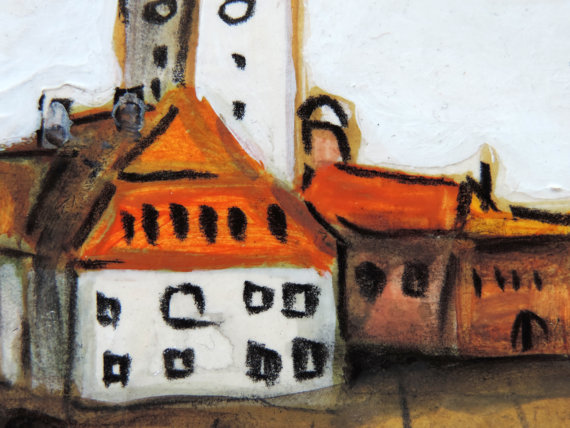
I've been renewing, reducing prices and polishing my Etsy Shop in preparation for the holidays season and I have rediscovered one of my personal favorites - a bright miniature inspired by the old town center of Brasov (Kronstadt), a Saxon town in southern Transylvania, in Romania.
Through a mix technique (pencil sketch and acrylic colors) I tried to capture the charming perspective, color, and light of this area, called "The Town Council House" (i.e. the town hall).
Dimensions: 9.5 x 10 cm (3.7 x 3.9 inches). 
Feel free to visit GoddessGruia temple aka Etsy Shop HERE
See the listing HERE.
The work can be included among my medieval architecture-inspired acrylic paintings that I have presented before.


31/10/2016

Tooth powders

Different recipes for products meant to clean and whiten the teeth and to freshen the breath are known ever since Classical Antiquity. The Greeks and the Romans often used dentifrices (tooth powders) made of burnt and finely crushed bones and shells, sometimes mixed with honey and various astringent substances (such as myrrh).
Pharmacists prepared such products from the end of the Middle Ages and until the beginning of the twentieth. The recipes are mentioned in the different specialized works and the products are a constant presence in the Materia medica.


Dentifrices are defined as mechanical cleaning agents, usually powders, for the cleaning of teeth, usually made of the following main ingredients:
  • Pumex - pumice stone
  • Bolus Armeniaca - red clay
  • chalk
  • Ossae Sepiae - cuttlefish bone
  • Myrrha - myrrh
  • Iridis Florentinae Radix - Iris bulb
  • Catechu - acacia extract
  • Sanguis Draconis - the resin of certain wild palm trees
Some of the ingredients were used for their roughness, others for their astringent properties (addressing certain gum issues), while yet other for their nice smell, aimed at freshening one's breath. These types of ingredients had to be carefully balanced, so as to clean efficiently but not affect the enamel.


The History of Pharmacy Collection in Cuj-Napoca includes a series of containers for dentifrices, made of wood, glass and porcelain. Three of the items are wooden apothecary jars used during the nineteenth century in a pharmacy from Baia Mare, with painted signatures that indicate the type of product contained: "Pulv(eris) Dentifr(icium) Alb(um) and "Pulv. Dentif. Rub(rum)" thus differentiate between red and white tooth powders. "Pulv. Dentif' "Sipos""  probably refers to a special recipe, bearing the name of its inventor. Another apothecary jar, made of milky glass, dated to the nineteenth century, has the signature "Pulv. Dentif. Huf." and is part of the old Orient collection.


Red dentifrice preserved in one of the apothecary jars

Odontine container preserving the original tooth paste

The last two items are rectangular cases for tooth powder produced in Paris. One of them is made of porcelain, was obtained from the "Crown" Pharmacy in Iasi and the markings on the lid provide a series of clarifications. "Odontine" was a recipe launched in 1860 by chemist J. Pelletier, member of the French Academy of Medicine, at the suggestion of a dentist-surgeon colleague. The composition of this tooth paste was aimed at counteracting oral acidity, as a way to prevent the formation of cavities. The second box, made of milky glass, produced by the Bigaud company in Paris contained another tooth paste. The lid is marked "Pate dentifrice Bigaud Paris". The item is part of the old Orient Collection, thus not much is known on where it was sold in Transylvania. 
19th-century Odontine commercial (French)

Imported mineral water

The History of Pharmacy Collection in Cluj includes five nineteenth-century ceramic bottles obtained through the nationalization of the St. George Pharmacy in Cluj and a pharmacy in Carei. The stamps on these bottles confirm their German origin, from Nassau, and their initial contents that was mineral water. One of the ceramic bottles still has its cork stopper in place, thus preserving its original content.
19th-c stoneware bottle for Selters water

The mineral springs in Selters, near Strassbourg, were famous ever since Antiquity for the special properties of their water rich in sodium and alkaline salt. Selters luxury mineral water started to be sold on an international scale from the middle of the eighteenth century and around 3 million bottles were sold in 1850. Read more of the history HERE.
Special pottery bottles were created in order to preserve the properties of these waters. Their neck was very short, in order to eliminate water from the bottle during bottling. Despite their outlook, these containers produced in the area of Westerwald are not glazed, but coated in salt before firing, thus according to the stoneware technique. Unlike glazing, this method was simple and less costly, as no secondary firing was required. Glass bottles became increasingly popular in the end of the nineteenth century and the production of stoneware bottles dropped drastically.
On the basis of the stamps, the containers can be dated to the 1936-66 and 1866-1880 intervals. The stamps employed during the first period consist of a circular medallion with the depiction of a rampart lion and the inscription SELTERS on the shoulder of the bottle and below, horizontally, the inscription HERZOGTHUM NASSAU (the duchy that owned and sold the water, today Hesse). The label was different during the second interval, as the medallion now contained the depiction of a two-headed eagle surrounded by the inscription SELTERS NASSAU.

1866-1880 Selters logo

1936-1966 Selters logo
Selters mineral water was often prescribed during the nineteenth century and doctors recommended up to two liters a day, either as such or mixed with wine, during lunches. 

Selters salt glazed bottles at the History of Pharmacy Collection in Cluj

Detail of intact stopper

29/10/2016

INDIGO


The history of indigo is foremost that of a very valuable cloth dye. Its economical importance was due to the rarity of the natural substances from which blue hues could be obtained. Initially, the plant Indigofera tinctoria was used for such purposes in India and reached the Greek and Roman world as a luxury product called Indigo (from the Lat. indicum, Indian). Different European plants were also used during the Middle Ages, but the dye they produces was neither intense nor resistant. Thus, the discovery of wild indigo (Baptisia tinctoria) native of North America has generated an intense trans-Atlantic commerce with this new type of indigo. The Native Americans used the root of the plant medicinally as well, in the treatment of wounds that would not heal and of the infections of the mouth and throat. Indigo was thus added to the miraculous plants from the new continent, entering the European materia medica and used in healing numerous afflictions.

natural indigo dye
Baptista tinctoria - American wild indigo

 During the nineteenth century indigo started to be used in homeopathy as well, especially an immune system stimulant, in combination with other plants, but also in cases of localized infections. As an antimicrobial tincture, it is usually associated with Echinacea and wild cedar. 


            The History of Pharmacy Collection from Cluj-Napoca, includes five jars for indigo used in Transylvania apothecaries. The first two jars, made of wood, were obtained from the Unicorn pharmacy in Cluj; the first is dated to the nineteenth and the second to the eighteenth century. The third jar, also made of wood, was once used in the Bononi pharmacy in Recaş (Timiş County). The fourth container is a glass jar with the signature INDIGO printed on paper, part of the old Orient collection. The final item is a small bottle from a homeopathy set from the pharmacy in Baia Mare. 
wooden apothecary jars from the Unicorn pharmacy in Cluj with the signature INDIGO


apothecary jars for Indigo from Recas and an unknown location

27/10/2016

Castoreum


Castoreum is a yellowish, oily, vanilla-scented excretion from the castor sacs in both male and female beavers, employed by the animals to mark their territory. The substance is still used in the perfume industry, but was famous since Antiquity as a cure. It seems its action is due to the salicin content from the beavers’ diet, being thus similar to aspirin.
18th-century drybeaver sacks

Castoreum is mentioned in all apothecary inventories, taxes and pharmacopoeias from early modern Transylvania. It was recommended against epilepsy, cholera, but also hysteria due to its analgesic and anti-inflammatory properties.
In 17th-19th century Transylvania the apothecaries used Castoreum from England (Anglicum), Russia (Moscoviticum) and Canada (Canadense) as tincture, essence, and powder.
The History of Pharmacy Collection in Cluj includes 10 jars, of all types, for Castoreum-based products. Castoreum Moscoviticum, from Moscow, was the most popular among them. Eighteenth-century dried beaver glands are also preserved from the pharmacy in Baia Mare. A small bottle from a portable pharmacy is also dated to the same century and was used for Castoreum Essence. From the nineteenth century we display wooden and milky glass jars from pharmacies in Carei, Braşov and Recaşul de Timiş, while the blues glass jar is from the twentieth century and was used in the old Hintz pharmacy that hosts the museum today.
20th-century blues glass bottle for Castoreum Tincture

18th-century small bottle for Castoreum Essence from the portable apothecary chest of Theresa Kemeny
See all photos and the story of the ingredient in Romanian HERE and follow the official blog of the History of Pharmacy Museum in Cluj-Napoca, heart of Transylvania.

eighteenth century engraving depicting a beaver - castor

25/10/2016

Tarabostes

The ancient sources mention two social categories among the Dacians - their noblemen, called TARABOSTES or PILEATI were those of rank, standing out through their wearing of the pileus, a typical hat with an in-turned tip, and the COMATI, those who were forbidden such an accessory and carried on bare headed.
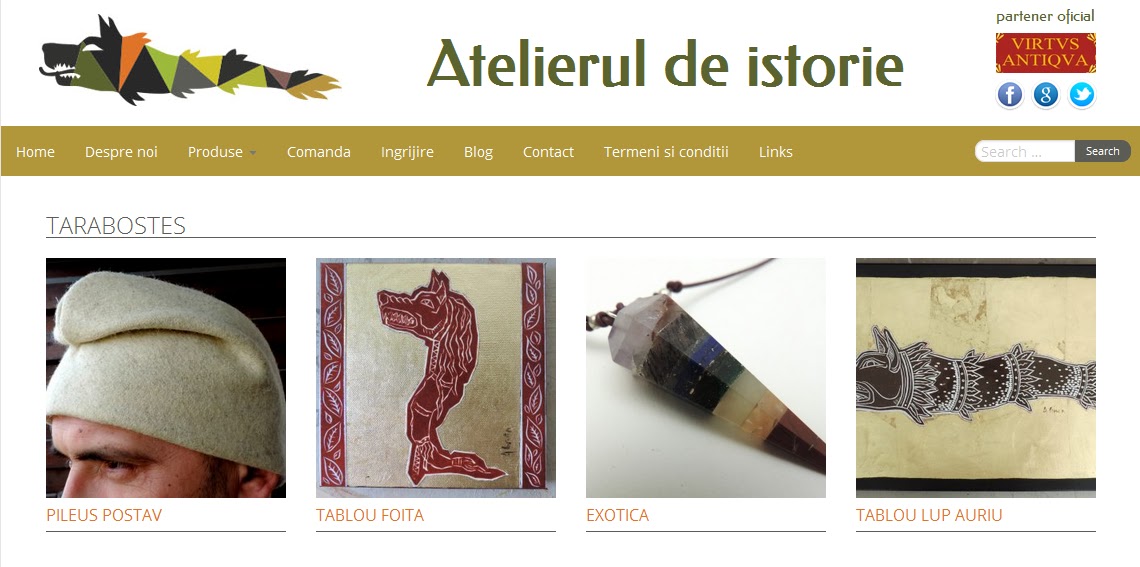
Our workshop selling handmade items inspired by the ancient Roman and Dacian civilizations has recently introduced a new category or luxury products, made of more expensive materials and exotica - called tarabostes. It includes the following items:
  • homemade spun woolen Dacian hat, pileus - available online, with description in Romanian, HERE.
  • two gilded original paintings with draco, the war standard of the Dacians - the rectangular one available HERE and the rectangular, larger one, HERE.
  • and special jewelry necklaces and pendants of the exotica type, available at atelieruldeistorie.ro HERE.

24/10/2016

Banffy palace Cluj - gilded linocut

Goddess Gruia has visited her Sancta Sanctorum, aka studio, this weekend, preparing a new gilded linocut experiment. Unlike the previous prints created in this technique, I have adapted certain elements, while other effects were unintentional. This print, rendering the Banffy Palace, currently the Art Museum in Cluj-Napoca in a decorative frame, was very static and symmetric. I thus though to liven it up a bit with the gold foil and the writing inside the frame. The accident was that the lino printed part had not completely dried and the foil also stuck in some areas, though I confess not disliking the effect.
the print before applying the gold leaf

 linocut with imperfect gilding

 a bit of asymmetry in gilding the contours of the handwriting

23/10/2016

Homespun woolen cap

We finally found a seller of homespun woolen fabric in natural colors, thus the most recent variant of our reconstructed Dacian cap / hat is now more authentic than ever. The material is not so comfortable, but it is warm, thick and the typical pointy end is now prominent. Such hats were being worn by Dacian noblemen (called tarabostes or pileati - those who wore the pileus), as depicted on Trajan's Column.
The cloth comes in natural wool colors, dirty white and brown.
The new type of pileus is available online, at atelieruldeistorie.


21/10/2016

Nineteenth-century guild certificate from Cluj

The National History Museum of Transylvania preserves in its collection a series of engraving plates for guild certificates. The nineteenth century plates were used to print "diplomas", official forms granted apprentices after presenting the masterpieces to the guild commission and becoming masters themselves. This particular print, recently pulled after the original plate, was employed by the carpenters' guild in Cluj, written in German and depicting a vedutta of the city of Klausenburg/Kolozsvar/Cluj. The main monuments are numbered and explained in the caption and the frame decorated with festoons is surmounted by the coat of arms of Cluj - a city gate with three towers.
The post card depicting this diploma can be acquired at the History of Pharmacy Collection.


An earlier and more famous view of the same city, labeled "Claudiopolis Coloswar vulgo Klausenburg, Transilvaniae civitas primara", has been created by Georg Houfnagel in 1617.